

Frequently Asked Questions
Is Centennial Hills a safe place to live?
Yes, Centennial Hills is widely considered one of the safer suburban areas in the Las Vegas Valley. It features master-planned safety designs, well-lit streets, and a family-oriented demographic. Crime rates in this area typically trend 30-40% below the Las Vegas citywide average, making it a popular choice for families and retirees seeking a secure environment.
What are the primary amenities in Centennial Hills?
The community is centered around the massive Centennial Hills Park, which offers an amphitheater, water play areas, and sports courts. Other key amenities include the Centennial Hills Library, a state-of-the-art YMCA, and the Centennial Hills Hospital medical campus. Nature lovers also enjoy proximity to Floyd Lamb Park and the Tule Springs Fossil Beds National Monument.
How far is Centennial Hills from the Las Vegas Strip?
Centennial Hills is located approximately 15-20 miles northwest of the Las Vegas Strip. Depending on traffic, the commute typically takes 25 to 35 minutes via the US-95 or the CC-215 Beltway. This location offers a quiet suburban lifestyle while maintaining convenient freeway access to the valley’s major employment and entertainment hubs.
Community Details
| Elementary School: | Marshall C. Darnell Elementary School | HOA: | No |
| Middle School: | Edmundo “Eddie” Escobedo Sr. Middle School | Guard Gated: | No |
| High School: | Centennial High School | Golf Community: | No |
| Jurisdiction: | City of Las Vegas | Luxury: | No |
| Primary ZIP: | 89135 | Equestrian: | No |
| Median Price: | $495,000 | Large Lots: | No |
| Region: | north_las_vegas | Historic: | No |
| Master Plan: | Centennial Hills | Walk Score: | 32 |
Description
**Centennial Hills: The High-Desert Jewel of the Northwest Las Vegas Valley**
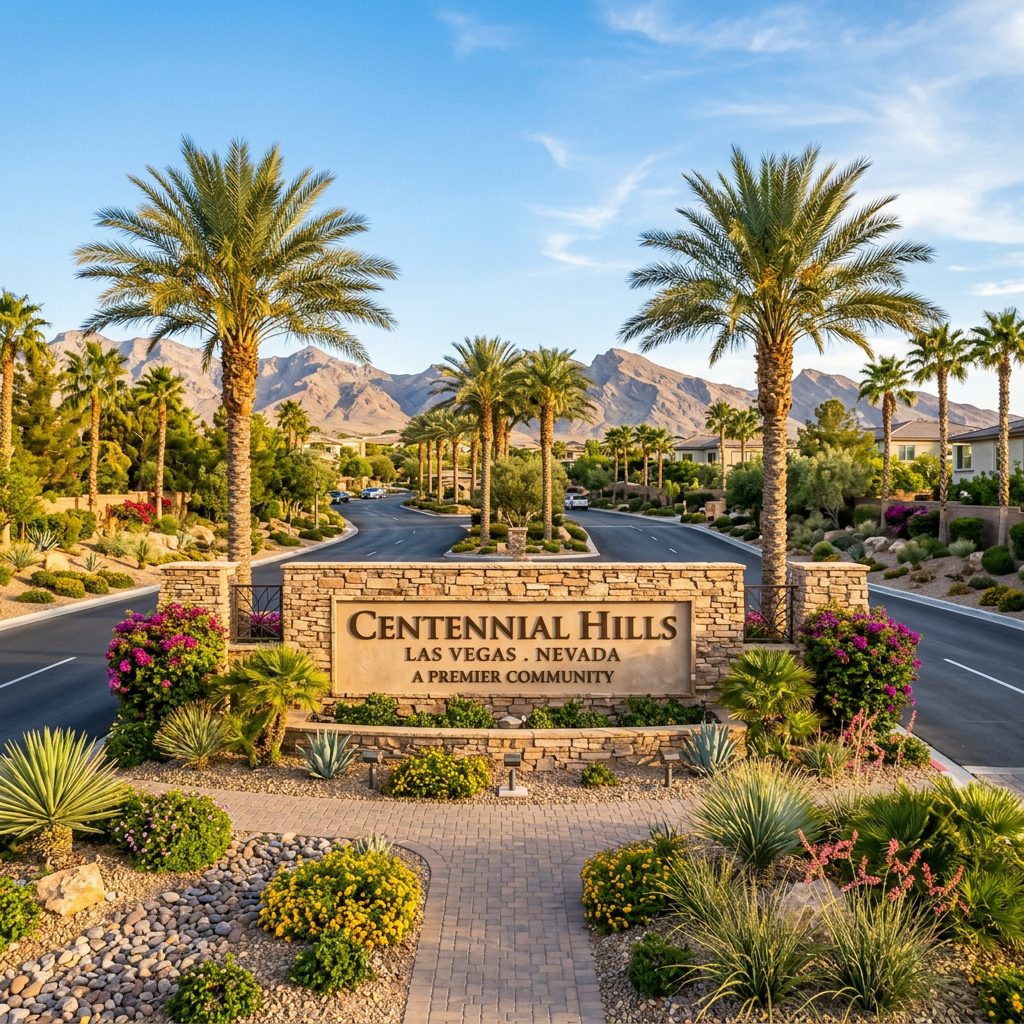
While often confused with the luxury enclaves of Summerlin South (ZIP 89135), **Centennial Hills** is the undisputed crown jewel of the Northwest Las Vegas Valley, primarily encompassing the **89149** and **89131** ZIP codes. Situated at an elevated vantage point that offers some of the clearest air and most striking “reverse” views of the Las Vegas Strip, Centennial Hills represents a master-planned evolution that balances high-density convenience with “Rural Preservation” roots.
1. Geography and Master-Planned Precision
Centennial Hills is located in the far northwest corner of the City of Las Vegas. It is physically defined by the massive “Centennial Bowl”—the interchange where US-95 meets the CC-215 Northern Beltway. This location is pivotal; it offers residents a straight shot south to Downtown Las Vegas (15 minutes) or the Strip (20–25 minutes), while providing the quickest access in the valley to Mt. Charleston and Lee Canyon.
The community is bounded roughly by Moccasin Road to the north, Lone Mountain to the south, Decatur Boulevard to the east, and the edge of the desert to the west. Unlike the desert-landscaped density of Henderson or Summerlin, Centennial Hills maintains a more open, airy feel, sitting at an elevation of approximately 2,500 to 3,000 feet.
2. A Vision of “Town and Country”
Development in Centennial Hills began in earnest in the early 2000s, spearheaded by the City of Las Vegas’s vision to create a “town center” concept outside of the urban core. The area was built to be self-sustaining. The **Centennial Hills Town Center** serves as the commercial heart, surrounded by residential “fingers” that stretch into the desert.
A unique historical aspect of this area is the **Rural Preservation Overlay**. Unlike almost any other master-planned area in Clark County, Centennial Hills protects specific pockets where residents can own horse property and minimum half-acre lots without sidewalks or streetlights. This creates a fascinating architectural tapestry where a modern, gated KB Home subdivision might sit directly across the street from a multi-million dollar custom equestrian estate.
3. Diverse Housing and Renowned Builders
Centennial Hills is a stronghold for major national builders who have utilized the rolling topography to create diverse products.
* **The Builders:** You will find significant footprints from **Pulte, Lennar, Richmond American, and KB Home**. Recently, **Toll Brothers** has moved into the area with luxury developments like *Franklin Park at Providence* (which sits on the edge of Centennial Hills).
* **The Product:** Housing ranges from modern three-story townhomes near the Town Center to expansive single-story estates. Square footages typically range from 1,400 sq. ft. for starter homes to over 5,000 sq. ft. for custom builds in the northern sections.
* **HOA Nuance:** While many neighborhoods are governed by HOAs (averaging $50–$120/month), the rural preservation areas have no HOA fees, a major draw for buyers seeking autonomy.
4. Market Trends and Buyer Demographics
Centennial Hills has seen aggressive appreciation due to its “relative” value compared to Summerlin. While a 3,000-square-foot home in Summerlin South might command $1.2 million, a similar home in Centennial Hills often lists in the $700,000 to $850,000 range.
The buyer profile is distinct: a heavy concentration of **Creech and Nellis Air Force Base personnel** (due to the easy freeway access), healthcare professionals working at the **Centennial Hills Hospital**, and families who prioritize backyard space over proximity to the Strip.
5. Unrivaled Amenities and Lifestyle
The lifestyle here is defined by the outdoors and civic investment:
* **Centennial Hills Park:** An award-winning 120-acre park featuring an inverted-amphitheater, soccer fields, and a massive water-play area. It is the site of frequent community concerts and the “Northwest Fourth of July” fireworks.
* **The YMCA and Library:** The Centennial Hills Community Center (operated by the YMCA) and the adjacent state-of-the-art Centennial Hills Library form a massive 100,000+ square-foot campus for fitness and learning.
* **Floyd Lamb Park at Tule Springs:** Located just minutes north, this historic 2,040-acre park features lush greenery, lakes with fishing, and wandering peacocks—a true anomaly in the Mojave Desert.
6. Education and Infrastructure
The community is served by some of the newest schools in the Clark County School District (CCSD), including **Arbor View High School** (known for its strong athletic programs) and **Shadow Ridge High School**. The area is also a hub for charter school options, including the highly-rated **Somerset Academy (Sky Pointe Campus)** and **Founders Academy**.
7. Retail and Dining: The Centennial Center
Residents rarely have to leave the neighborhood for essentials. The **Centennial Center** and **Monte Vista Village** offer millions of square feet of retail.
* **Dining:** Local favorites include *702 Taphouse*, *Sienna Italian*, and the popular *Honey Salt* (nearby in the Rampart area).
* **Grocery:** The area is served by Smith’s Food & Drug, Albertsons, and a high-traffic **Trader Joe’s** at the 215/Centennial Pkwy interchange.
8. What Makes Centennial Hills Different?
The defining characteristic of Centennial Hills is its **”Skyline and Stone”** aesthetic. To the west, you are staring directly into the limestone cliffs of the Spring Mountains; to the east, the entire Las Vegas Valley unfolds below you. It feels less like a “tourist town” and more like a traditional American suburb that happens to have a world-class skyline in its backyard. For the buyer who wants a three-car garage, a sprawling park within walking distance, and a 30-minute commute to the slopes of Lee Canyon, Centennial Hills is the ultimate Northwest destination.
© Copyright 2026 Michael Pollastro & MyLasVegas. All rights reserved on all content contained herein.


