

Frequently Asked Questions
Is John S Park a designated historic district?
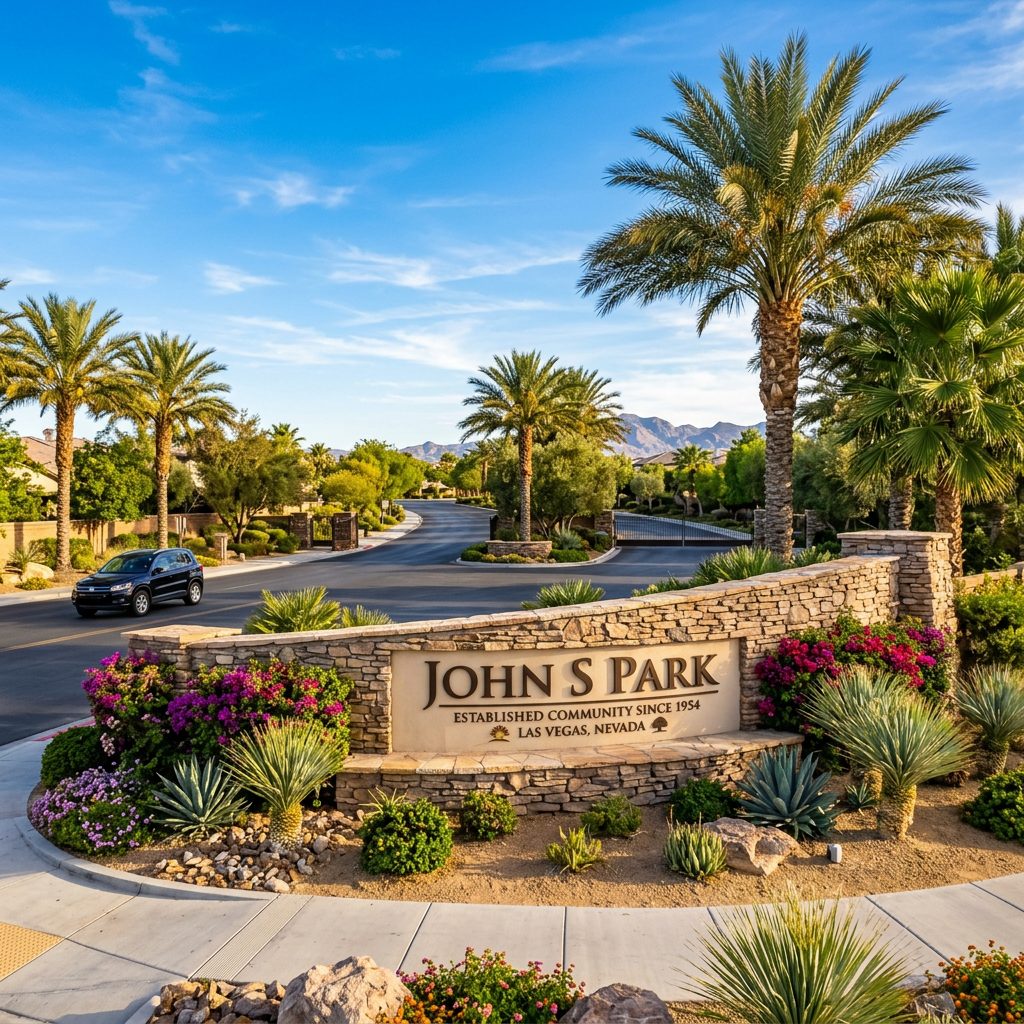
Yes, John S Park is one of the most prominent historic districts in Las Vegas. It was the first neighborhood in the city to be designated as a local historic district (March 2003) and is also listed on the National Register of Historic Places. The area is protected to preserve its unique architectural heritage and pre-casino era suburban character.
What architectural styles are common in John S Park?
The neighborhood features a diverse mix of mid-20th-century styles, including Tudor Revival, Minimal Traditional, and Ranch-style homes. Many residences were built between 1931 and 1956, showcasing the English Garden City planning philosophy with curvilinear, tree-lined streets that contrast with the typical Las Vegas grid.
Does the John S Park neighborhood have an HOA?
John S Park does not have a traditional, mandatory Homeowners Association (HOA) with monthly dues. However, it has a very active Neighborhood Association that advocates for residents and helps maintain the historic integrity of the area. Homeowners must adhere to historic district design guidelines for any exterior renovations or construction.
Community Details
| Elementary School: | John S. Park Elementary School | HOA: | No |
| Middle School: | Roy Martin Middle School | Guard Gated: | No |
| High School: | Valley High School | Golf Community: | No |
| Jurisdiction: | City of Las Vegas | Luxury: | No |
| Primary ZIP: | 89144 | Equestrian: | No |
| Median Price: | $425,000 | Large Lots: | No |
| Region: | downtown | Historic: | Yes |
| Master Plan: | Walk Score: | 79 |
Description
**The Timeless Allure of the John S. Park Historic District: A Bastion of Old Las Vegas Elegance**
In a city often defined by its rapid expansion and “new is better” philosophy, the John S. Park Historic District stands as a sophisticated rebuttal. Located in the heart of the **89104 ZIP code** (though often colloquially associated with the downtown transition corridor), this neighborhood is one of the most coveted historic enclaves in the Las Vegas Valley. While the modern master-planned developments of 89144 (Summerlin Centre) offer a different kind of luxury, John S. Park provides a soulful, architectural pedigree that cannot be manufactured by a contemporary developer.
A Geographic and Historical Landmark
The John S. Park neighborhood is situated just south of the Arts District and East Fremont, roughly bounded by **Charleston Boulevard to the north, Sahara Avenue to the south, Las Vegas Boulevard to the west, and 9th Street to the east.** Its location is unparalleled for those who crave urban connectivity; it is less than five minutes from the world-famous Las Vegas Strip and the burgeoning professional hub of Downtown Las Vegas, with immediate access to the I-15 and US-95 interchanges.
Named after John S. Park, a prominent local banker and school board president who arrived in the valley in 1899, the neighborhood began its first phase of development in 1931 with the “Parkside” subdivision. Construction flourished through the 1940s and reached completion in the mid-1950s. Unlike the repetitive “cookie-cutter” tracts seen in later decades, John S. Park was envisioned as a high-end residential retreat for the city’s early professional class—lawyers, doctors, and casino executives who wanted to live near the city center but in a secluded, prestigious environment.
Architectural Diversity and Housing Product
What distinguishes John S. Park from any other neighborhood in Clark County is its eclectic mix of mid-century architectural styles. You will find no stucco-and-tile uniformity here. Instead, the streets are lined with:
* **Minimal Mansard and Tudor Revivals:** Rare for the desert, these homes date back to the early 1930s.
* **Mid-Century Modern Ranches:** Built in the late 1940s and early 50s, these feature the iconic low-slung rooflines, expansive floor-to-ceiling windows, and integrated indoor-outdoor living spaces.
* **Colonial and Cape Cod Revivals:** Reflecting the traditional tastes of the era’s elite.
Homes typically range from **1,500 to over 4,000 square feet**, sitting on generous, oversized lots that average between 0.20 and 0.40 acres. Because this is a designated Historic District (added to the National Register of Historic Places in 2003), there are specific guidelines for exterior renovations, ensuring that the neighborhood maintains its 1940s character. Notably, there is **no traditional HOA fee**, though the city’s historic preservation ordinances act as a de facto safeguard for property values.
Market Trends and Residents
The real estate market in John S. Park is characterized by low inventory and high demand. Long-term residents often stay for decades, and when homes do hit the market, they frequently attract multiple offers from “urban pioneers” and luxury buyers looking for character. Current resale prices typically range from **$450,000 for smaller fixer-uppers to well over $900,000** for meticulously restored mid-century estates. The appreciation trend here has been bolstered by the “Downtown Renaissance,” as the area has transitioned from a hidden gem to a premier destination for the city’s creative and professional class.
The lifestyle here is decidedly “urban-sophisticate.” Residents include a mix of artists, judges, young professionals working in the nearby legal and tech sectors, and multi-generational families. The community culture is tight-knit, often centered around neighborhood walks under the canopy of some of the oldest and largest trees in the valley—a stark contrast to the desert landscaping of the suburbs.
Education and Amenities
The neighborhood is anchored by its namesake, **John S. Park Elementary School**, a historic institution that remains a focal point of the community. Older students typically attend **John C. Fremont Professional Development Middle School** and **Valley High School**, which hosts a prestigious International Baccalaureate (IB) program. For families seeking private education, the neighborhood is a short commute to the **Bishop Gorman High School** bus routes and near several charter options in the downtown core.
Retail and dining are where John S. Park truly shines. Residents are within walking distance or a two-minute drive of:
* **The Las Vegas Arts District:** Home to *Esther’s Kitchen*, *Velveteen Rabbit*, and dozens of galleries.
* **Fremont East:** Featuring local favorites like *Le Thai* and *The Griffin*.
* **Grocery/Convenience:** A short drive to the Whole Foods Market at Town Square or the local Albertsons on Charleston.
Why John S. Park?
The unique distinguishing feature of John S. Park is its “soul.” In a city that often implodes its history, John S. Park has preserved it. It is one of the few places in Las Vegas where you can find a true “neighborhood feel,” complete with sidewalks, mature pine and ash trees, and homes with individual names and histories. For the buyer who rejects the anonymity of the master-planned suburb and seeks a home with a story, John S. Park is the ultimate Las Vegas address.
© Copyright 2026 Michael Pollastro & MyLasVegas. All rights reserved on all content contained herein.


