

Frequently Asked Questions
What is the history behind the Boulder City Historic District?
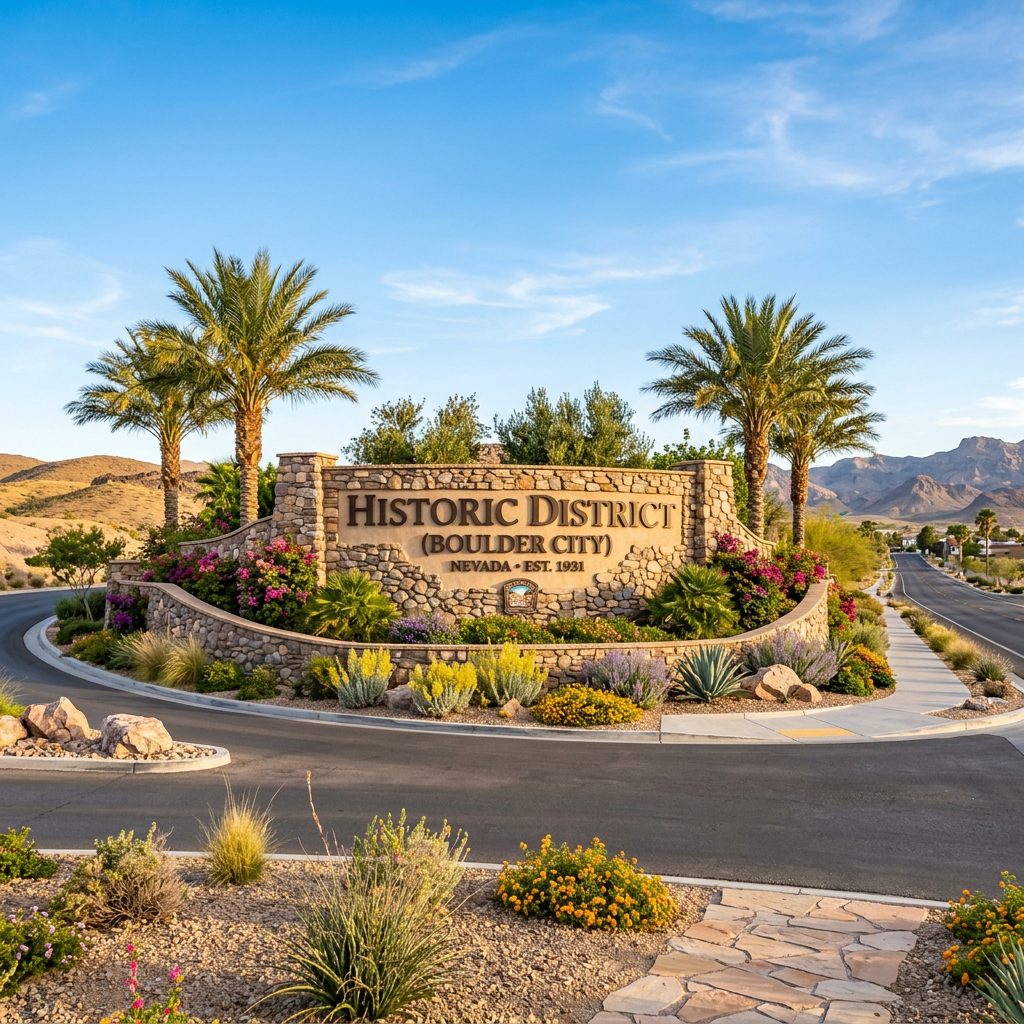
The district was established in the 1930s to house employees working on the Hoover Dam project. It was designed by landscape architect Saco Rienk DeBoer and is listed on the National Register of Historic Places, featuring a unique master-planned layout that emphasizes green space and community interaction.
What architectural styles are common in this area?
The Historic District showcases diverse early 20th-century architecture, including Dutch Colonial Revival, Spanish Colonial, and Minimal Traditional cottages. This architectural variety creates a distinct aesthetic compared to the newer master-planned developments found elsewhere in the Las Vegas Valley.
Are there special rules for renovating homes in the Historic District?
Yes, because the area is protected as a historic landmark, exterior renovations and modifications often require approval from the Boulder City Historic Preservation Committee. This ensures that the neighborhood maintains its original character and architectural integrity for future generations.
Community Details
| Elementary School: | Andrew J. Mitchell Elementary School, Martha P. King Elementary School | HOA: | No |
| Middle School: | Elton M. Garrett Junior High School | Guard Gated: | No |
| High School: | Boulder City High School | Golf Community: | No |
| Jurisdiction: | City of Boulder City | Luxury: | No |
| Primary ZIP: | 89012 | Equestrian: | No |
| Median Price: | $535,000 | Large Lots: | No |
| Region: | boulder_city | Historic: | Yes |
| Master Plan: | Walk Score: | 82 |
Description
The Living Legacy of the Dam: A Deep Dive into the Boulder City Historic District
While the rest of the Las Vegas Valley was built on a foundation of neon and gaming, the **Boulder City Historic District** stands as a remarkably preserved monument to federal planning and New Deal-era ambition. Located in ZIP code **89005** (often distinguished from the nearby Henderson ZIPs like 89012), this community is the “Green Heart” of the Mojave. It is the only municipality in Nevada where gambling remains illegal, creating a real estate micro-market that feels more like a mid-century Midwestern town than a desert metropolis.
1. Geography and Master-Planned Origins
The Boulder City Historic District is located approximately 25 miles southeast of the Las Vegas Strip, situated on a high plateau overlooking the Hemeway Valley and Lake Mead. The district is bounded roughly by **9th Street** to the north, **Canyon Road** to the west, **Fifth Street** to the south, and **Avenue B** to the east.
Unlike the sprawling subdivisions of the Las Vegas Valley, this was a “Model City” commissioned by the U.S. Bureau of Reclamation. It was designed in 1931 by **Saco DeBoer**, a renowned landscape architect who envisioned a “fan-shaped” townsite. The streets are famously categorized: “Alphabet Streets” (Arizona, California, Colorado, Denver, etc.) and “Numbered Streets,” all radiating from the central government administrative buildings that managed the construction of the Hoover Dam.
2. A Developer Like No Other: The Federal Government
The “developer” of the Historic District was the **U.S. Government** and the **Six Companies, Inc.** (the consortium that built the Dam). Construction began in 1931 to house thousands of workers. Because it was a “company town,” every tree, sidewalk, and park was meticulously placed to provide relief from the desert heat.
The district was managed by the federal government until 1958, when the city was officially incorporated and the land was sold to residents. This transition from federal oversight to private ownership has left the district with a degree of architectural consistency that is impossible to replicate in modern developments.
3. Housing Product and Architectural Diversity
The real estate in the Historic District is a tapestry of 1930s and 40s Americana. You will not find “cookie-cutter” stucco here. Instead, the neighborhood features:
* **Worker Cottages:** Small, charming bungalows ranging from 800 to 1,200 square feet, often featuring original wood siding or brick.
* **Executives’ Hill:** Located on the higher ground (including **Denver Street** and **Park Place**), these larger homes were built for the Bureau of Reclamation’s top engineers. These residences often feature **Spanish Colonial Revival**, **Dutch Colonial**, or **Art Deco** influences, with square footages reaching 2,500 to 4,000.
* **Mission and Streamline Moderne:** The district is famous for its “Dam Architecture”—clean lines, thick walls, and cooling porches designed before the advent of modern air conditioning.
* **Lot Sizes:** Lots are generally modest (6,000 to 10,000 sq. ft.), but they are exceptionally lush with mature pines, elms, and mulberry trees that are decades older than anything in Summerlin or Henderson.
4. Market Trends and Why Buyers Invest
The Historic District is one of the most stable real estate markets in Clark County. Because there is no room for “new” construction within the historic core, supply is perpetually capped.
* **Pricing:** Small cottages start in the high $300,000s, while restored estates on “The Hill” can exceed $1 million.
* **Appreciation:** Homes here command a “History Premium.” Buyers seek out this area specifically because it lacks an HOA. While the city has a **Historic Preservation Ordinance** that regulates exterior changes to maintain the neighborhood’s character, there are no monthly HOA dues, a rarity for such a well-maintained community.
5. Community Amenities and Lifestyle
Life in the Historic District revolves around **Wilbur Square** and **Bicentennial Park**, large grassy commons that host the famous “Art in the Park” festival and the Boulder City Santa Train.
* **Parks:** The neighborhood is walkable to **Hemenway Park**, famous for the desert bighorn sheep that frequently graze on the grass.
* **Recreation:** Residents have immediate access to the **Bootleg Canyon Mountain Bike Park** and are less than 10 minutes from **Lake Mead National Recreation Area**.
* **Golf:** The Boulder City Municipal Golf Course and Boulder Creek Golf Club offer world-class play without the high-end private club fees found in Las Vegas.
6. Education and Schools
Families are drawn to the district because of Boulder City’s “small-town” school ecosystem. Unlike the massive schools in Henderson, the schools here are smaller and deeply integrated into the community:
* **Martha P. King Elementary** and **Andrew J. Mitchell Elementary** provide the primary foundation.
* **Elton Garrett Junior High** and **Boulder City High School** (Home of the Eagles) are the pride of the town, consistently ranking high in Nevada for both academics and athletics.
7. Retail, Dining, and the “No-Gaming” Culture
The district’s commercial core along **Nevada Way** is a throwback to the 1940s. Residents walk to:
* **The Coffee Cup:** A local staple featured on “Diners, Drive-Ins and Dives.”
* **The Dillinger:** A high-end burger and craft beer joint located in an old bank building.
* **The Boulder Dam Hotel:** A historic landmark that serves as the cultural hub of the city, housing the Boulder City Hoover Dam Museum.
* **Grocery/Essential Retail:** While there is a Boulder City Albertsons and CVS, many residents take the short 10-minute drive into Henderson (89012/89052) for Whole Foods or the Galleria at Sunset mall.
8. Unique Distinguishing Features
The Boulder City Historic District is the only place in the Las Vegas Valley where you can experience **true “Small Town America”** with a desert backdrop.
* **The “Clean, Green” Image:** The city’s original nickname holds true; the sheer volume of mature greenery is unmatched in the valley.
* **The Silence:** Without the hum of slot machines or the density of high-rise apartments, the nights are significantly quieter than in Las Vegas or Henderson.
* **The Historic Preservation:** Every home tells a story of the men and women who “tamed the Colorado River.”
For the buyer who values architectural integrity, mature landscaping, and a community where the mailman knows your name, the Boulder City Historic District is not just a neighborhood—it is a piece of living history.
© Copyright 2026 Michael Pollastro & MyLasVegas. All rights reserved on all content contained herein.


