

Frequently Asked Questions
What defines the Maryland Parkway Corridor neighborhood?
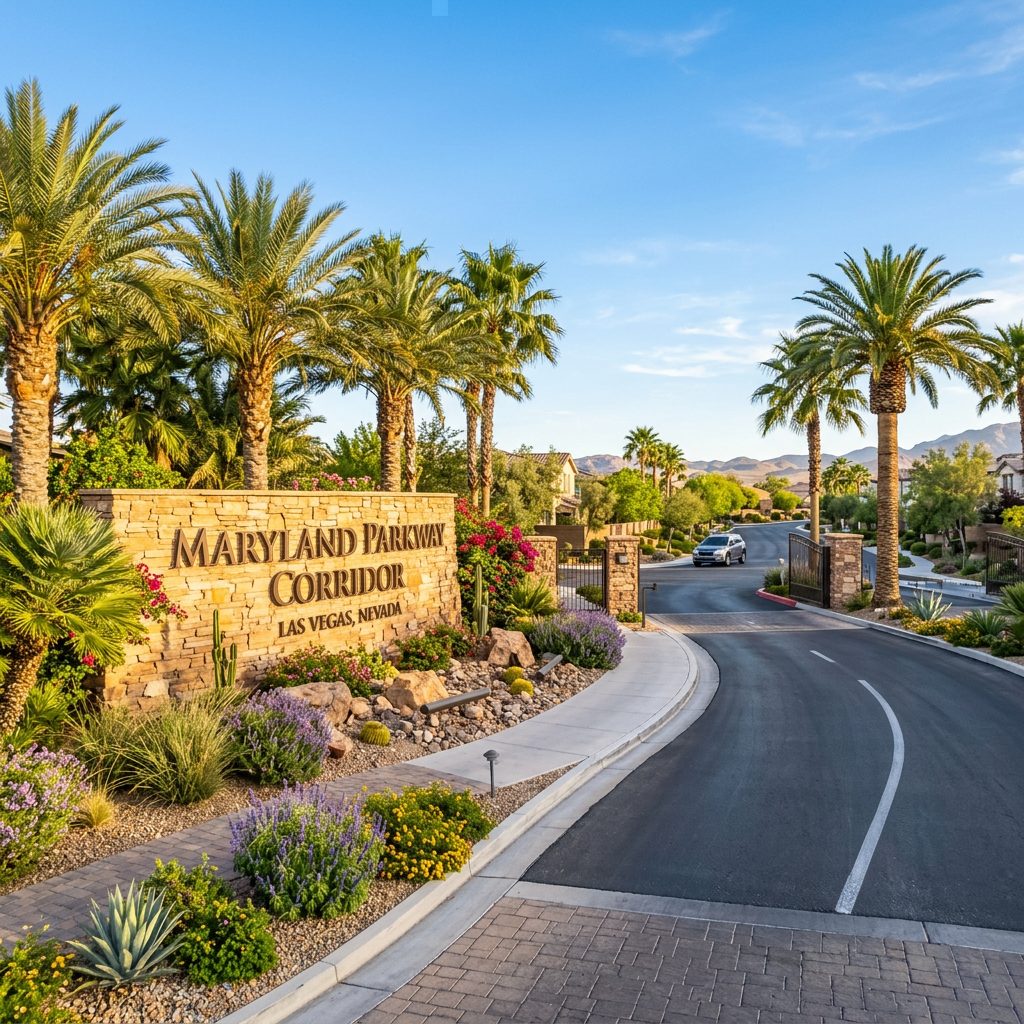
The Maryland Parkway Corridor is a vital 8.7-mile urban stretch connecting Downtown Las Vegas to Harry Reid International Airport. It serves as a major transit, academic, and medical hub, anchored by the University of Nevada, Las Vegas (UNLV) and Sunrise Hospital and Medical Center.
What kind of housing is available in the Maryland Parkway Corridor?
This area offers a diverse range of housing options, from mid-century modern ranch-style homes and vintage bungalows to high-density apartment complexes and renovated condominiums. It is particularly popular with university students, healthcare professionals, and those seeking a more urban, walkable lifestyle compared to the suburbs.
Are there major development projects planned for this area?
Yes, the Maryland Parkway Bus Rapid Transit (BRT) project is a significant initiative aimed at transforming the corridor. This project includes dedicated bus lanes, enhanced transit stations, improved pedestrian crossings, and expanded bike lanes to stimulate economic growth and transit-oriented development throughout the district.
Community Details
| Elementary School: | Paradise Elementary School | HOA: | No |
| Middle School: | John C. Fremont Professional Development Middle School | Guard Gated: | No |
| High School: | Valley High School | Golf Community: | No |
| Jurisdiction: | Clark County & City of Las Vegas | Luxury: | No |
| Primary ZIP: | 89011 | Equestrian: | No |
| Median Price: | $315,000 | Large Lots: | No |
| Region: | henderson | Historic: | No |
| Master Plan: | Walk Score: | 78 |
Description
**The Urban Spine Reimagined: A Real Estate Profile of the Maryland Parkway Corridor**
While often categorized by its proximity to the University of Nevada, Las Vegas (UNLV), the Maryland Parkway Corridor represents one of the most significant historical and geographic arteries in the Las Vegas Valley. Stretching from the edges of Harry Reid International Airport (89119) northward through the historic neighborhoods of 89104 and into the Downtown core (89101), this corridor is currently undergoing a massive multi-billion-dollar transit and infrastructure revitalization that is fundamentally shifting its real estate landscape.
Geography and the Urban Core
The Maryland Parkway Corridor is the central north-south lifeline of the valley’s eastern urban core. Located roughly two miles east of the Las Vegas Strip, it runs parallel to Las Vegas Boulevard. The corridor is anchored by three major hubs: Harry Reid International Airport at the south, UNLV and the Sunrise Hospital Medical District in the center, and the Fremont East/Arts District at the north. Its proximity to the I-15 and US-95 interchange (the “Spaghetti Bowl”) and the Desert Inn Arterial—the city’s only non-freeway underpass of the Strip—makes it one of the most accessible locations for professionals working in tourism, healthcare, or gaming.
A Legacy of Mid-Century Modernism
Unlike the master-planned stucco tracts of the 1990s, the Maryland Parkway Corridor is the birthplace of “Vegas Modern.” The most prestigious development within this corridor is **Paradise Palms**. Built primarily in the early 1960s by Paradise Homes (led by legendary developers Irwin Molasky and Nathan Adelson), it was the first master-planned community in the valley.
The architecture here is iconic, featuring designs by **Palmer & Krisel**, a firm synonymous with Palm Springs modernism. Real estate here is characterized by:
* **Architectural Styles:** Mid-Century Modern (MCM) “butterfly” roofs, folded plate rooflines, and decorative breeze blocks.
* **Housing Product:** Large ranch-style homes ranging from 2,000 to over 4,000 square feet, often situated on oversized 1/4-acre to 1/2-acre lots.
* **Historic Districts:** The Beverly Green and Bel Air neighborhoods offer smaller, preserved post-war cottages and “Cinderella” ranches that appeal to design enthusiasts and urban preservationists.
Market Dynamics and The “University District” Shift
The real estate market along Maryland Parkway has seen a significant “buy-and-hold” trend. Historically, homes in Paradise Palms could be acquired for under $300,000, but the MCM revival has pushed current valuations between $550,000 and $850,000 for restored properties.
Investors have heavily targeted the 89119 and 89121 portions of the corridor for student housing and medical professional rentals. There is a lack of new-build single-family homes; instead, the market is defined by “adaptive reuse” and high-density infill. Currently, the RTC’s Maryland Parkway Bus Rapid Transit (BRT) project is sparking a wave of transit-oriented development (TOD), with developers looking to build mixed-use podium buildings that combine ground-floor retail with luxury apartments.
Lifestyle: From Campus to Culture
Life on the Maryland Parkway Corridor is distinctively urban. Residents trade the gated-wall privacy of Summerlin for a high-walkability lifestyle.
* **Amenities:** The corridor is anchored by the **Boulevard Mall**, Nevada’s first indoor shopping center, which has recently pivoted to include massive office components and an aquarium (SeaQuest).
* **Parks and Recreation:** Sunset Park, one of the largest in the county, sits just south of the corridor, while the **UNLV Marjorie Barrick Museum of Art** and the **Artemus W. Ham Concert Hall** provide a level of cultural access not found in the suburbs.
* **The “Secret” Golf Course:** The corridor is adjacent to the **Las Vegas National Golf Club**, a historic course that wound through the backyards of the “Rat Pack” in Paradise Palms.
Education and Healthcare Anchors
The corridor is the intellectual and medical heart of Clark County.
* **UNLV:** With over 30,000 students and 3,000 employees, the university drives the local economy and rental market.
* **Sunrise Hospital & Medical Center:** As the largest acute care facility in Nevada, it creates a massive demand for nearby housing for residency students and surgical staff.
* **Schools:** The area is served by the Clark County School District (CCSD), including **Valley High School**, which hosts a prestigious International Baccalaureate (IB) program and an Academy of Hospitality and Tourism. For elementary options, the **John S. Park Elementary** serves the historic northern end of the corridor.
Dining and Retail: The International Epicenter
One of Maryland Parkway’s most compelling features is its status as a “foodie” destination. The stretch between Desert Inn Road and Flamingo Road features a dense concentration of authentic international cuisine.
* **Retail/Dining:** From the historic **Piero’s Italian Cuisine** (a mob-era favorite) to the trendy coffee shops like **PublicUs** nearby, the corridor offers a gritty, authentic alternative to the polished Strip. Grocery needs are met by a mix of traditional Vons/Smith’s and specialty markets catering to the diverse UNLV population.
Distinguishing the Corridor
What makes the Maryland Parkway Corridor unique is its **architectural soul.** In a city often criticized for being “temporary,” this area feels permanent. It is the only neighborhood in Las Vegas where you can find a genuine Palmer & Krisel home, walk to a Tier 1 research university, and be at a Golden Knights game or a Broadway show at The Smith Center within a ten-minute bike ride. As the city moves toward a more transit-dense future, this corridor is the literal blueprint for the New Las Vegas urbanism.
© Copyright 2026 Michael Pollastro & MyLasVegas. All rights reserved on all content contained herein.


